
Natural Environmental Teaching (NET)
What is Natural Environment Teaching (NET)?
Natural Environment Teaching (NET) refers to systematic, planned instructional strategies delivered within settings that closely resemble a child’s typical environment. Often conducted through play-based and child-led activities, NET contrasts with more adult-directed, massed trial approaches common in Applied Behavior Analysis (ABA). It aims to teach language, communication, social, cognitive, and motor skills through meaningful, motivating, and naturalistic interactions.
Unlike the misconception that NET means unsystematic or unplanned teaching, effective NET is intentional and evidence-based while providing flexibility and promoting child engagement.
Core Principles of NET
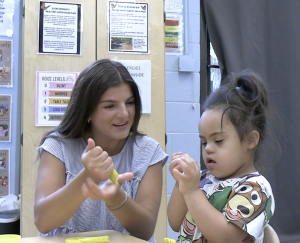
Child-led, play-based, and developmentally appropriate:
Children select activities and materials, which increases engagement and intrinsic motivation.
Embedded teaching opportunities:
Instruction is integrated into ongoing routines—such as snack, play, or transitions—rather than isolated drills (Halle & Anderson, 1984).
Balanced adult involvement:
Adults observe, imitate, expand, and respond to the child’s initiations to scaffold learning without making excessive demands.
Natural language modeling:
Adults model and expand language within context—by narrating actions, adding vocabulary, or imitating play.
Use of motivating materials:
Adults control access to preferred items or activities to create natural communication opportunities (Hart & Risley, 1975).
Focus on social communication and engagement:
NET supports reciprocal relationships and shared enjoyment, rather than reinforcing compliance alone (Schreibman et al., 2015).
Why NET Matters in Early Childhood Education
Research Foundation:
Since its introduction by Halle and Anderson (1984), NET has been shown to reduce the need for later stimulus control transfer and to foster skill generalization through real-world practice. Studies demonstrate that NET is highly effective for early learners with disabilities, particularly those with autism spectrum disorder (Koegel et al., 1987; Schreibman et al., 2015; Sandbank et al., 2020).
Benefits of NET:
- Promotes intrinsic motivation and engagement.
- Encourages functional communication and social interaction.
- Builds skills that generalize across settings and people.
- Aligns with both developmental and behavioral models of learning.
- Fosters collaboration between special education teachers and BCBAs in inclusive environments.
Core NET Strategies
Incidental Teaching
Developed by Hart & Risley (1975), this foundational NET strategy uses natural opportunities that the child initiates
Goal: Expand spontaneous communication and promote independent requesting
Steps:
Identify a motivating activity or object the child wants.
Wait for the child to initiate or show interest.
Prompt or model the target response (e.g., “Say ‘car please’”).
Reinforce the child’s attempt with access to the item.
Mand-Model Procedure
Designed for learners who may not spontaneously initiate communication.
Goal: Increase opportunities for children with emerging verbal skills to communicate successfully
Steps:
Adult presents a motivating item (e.g., a closed container).
Adult prompts or models a mand (“Say ‘open please’”).
Reinforce any appropriate communicative response
Pivotal Response Training (PRT)
A cornerstone naturalistic method focusing on motivation, child choice, and natural reinforcement (Koegel & Williams, 1980)
Outcome: Enhances generalization, persistence, and spontaneous social communication (Schreibman et al., 2016).
Key Components:
Shared control between child and adult.
Reinforcement directly related to the behavior.
Mixing mastered and new tasks to sustain engagement.
Interrupted Chain Procedure
Adults deliberately interrupt a familiar activity (e.g., missing a puzzle piece) to elicit communication
Outcome: Encourages problem-solving, persistence, and communicative repair behaviors.
Responsive Strategies
The following video will give examples of:
- Linguistic Mapping: Narrating the child’s actions to connect language and meaning.
- Contingent Imitation: Imitating the child’s play or sounds to increase joint attention.
- Modeling: Demonstrating actions or language slightly above the child’s current level.
- Play and Language Expansions: Building upon what the child says or does to extend learning.
Things to consider when using NET:
- Limit demands and adult talk except to respond to, imitate, and expand on child initiations.
- Allow children time and space to initiate and respond spontaneously, especially for those who initiate infrequently.
- Use child-directed strategies to support social communication and engagement, and consider more adult-directed approaches for teaching academic, pre-academic, or motor skills.
- Match language expansion rate to child communicative frequency, especially with low-rate talkers, to avoid overwhelming.
Popular NET-Associated Interventions (NDBIs)
Naturalistic Developmental Behavioral Interventions (NDBIs) are closely related to NET and include evidence-based models such as:
- Pivotal Response Training (PRT)
- Incidental Teaching
- Enhanced Milieu Teaching (EMT)
- JASPER (Joint Attention, Symbolic Play, Engagement, and Regulation)
- Reciprocal Imitation Training (RIT)
- Project ImPACT
- Early Start Denver Model (ESDM)
These models differ in focus but share the use of child-led, play-based contexts to teach communication, play, and imitation skills.
Procedural Guidelines
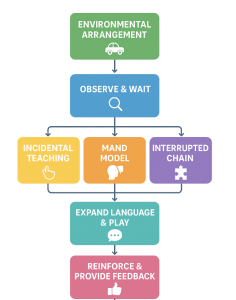
A structured process ensures consistency and fidelity in NET implementation.
Key Components:
- Environmental Arrangement – Set up play spaces with accessible, motivating materials.
- Observe and Follow the Child’s Lead – Join the play at the child’s level.
- Embed Teaching Opportunities – Prompt naturally during play.
- Reinforce with Natural Consequences – Use the activity itself as reinforcement.
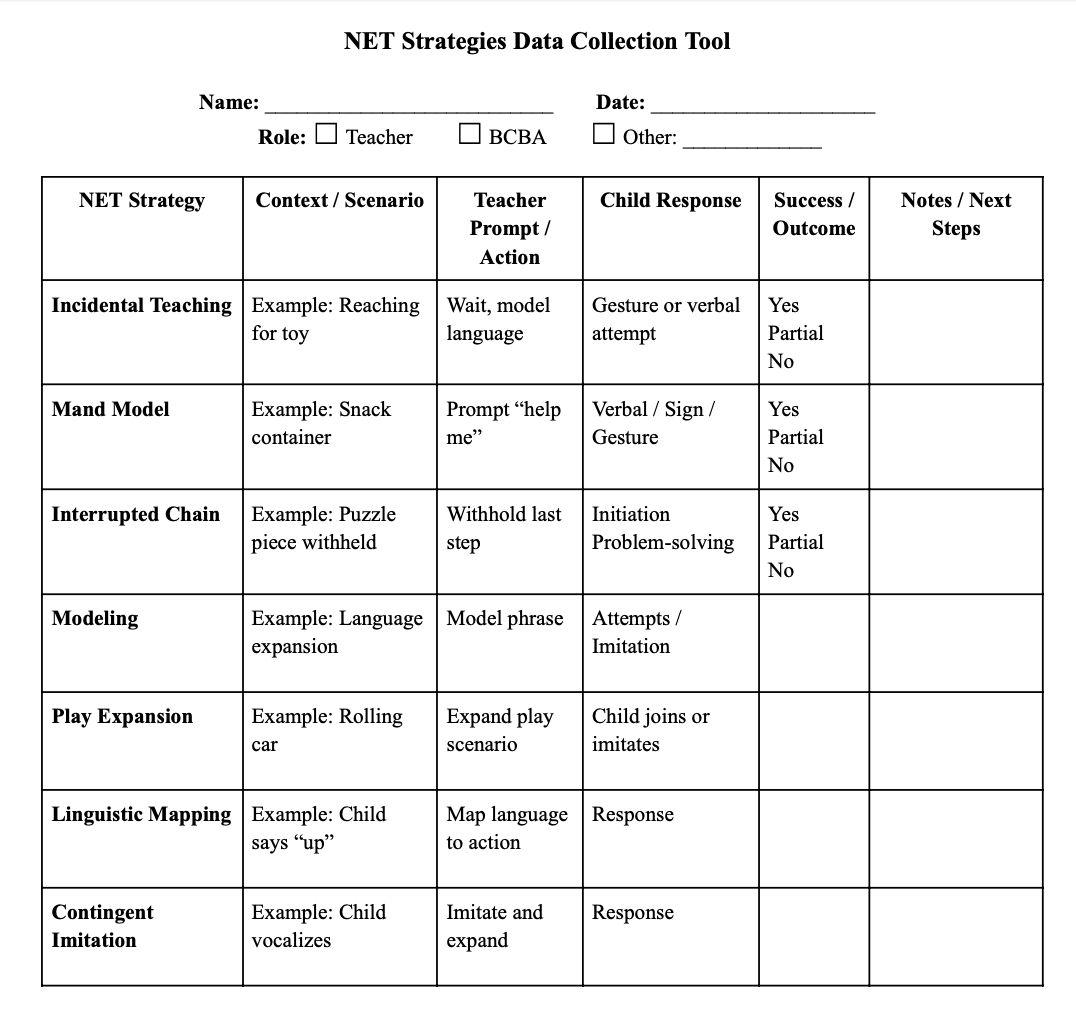
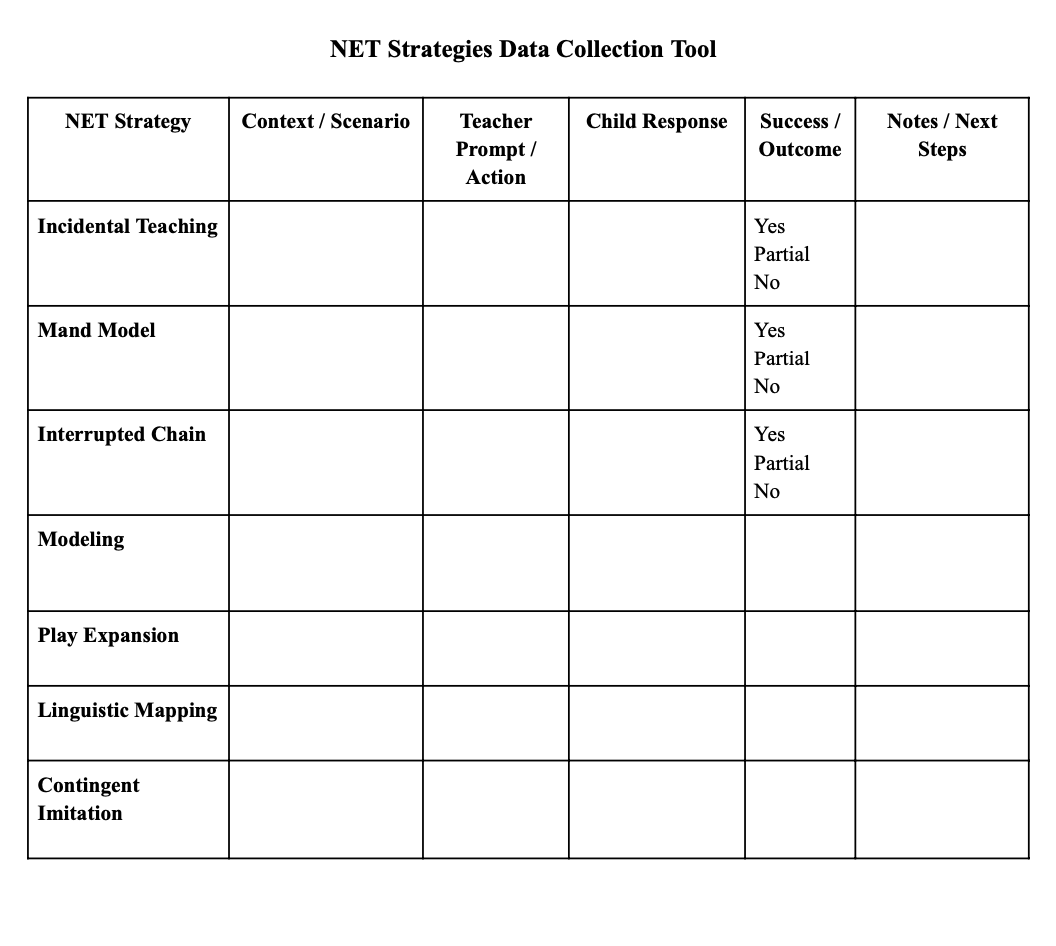
- Collect Data and Reflect – Record communication attempts, responses, and independence.

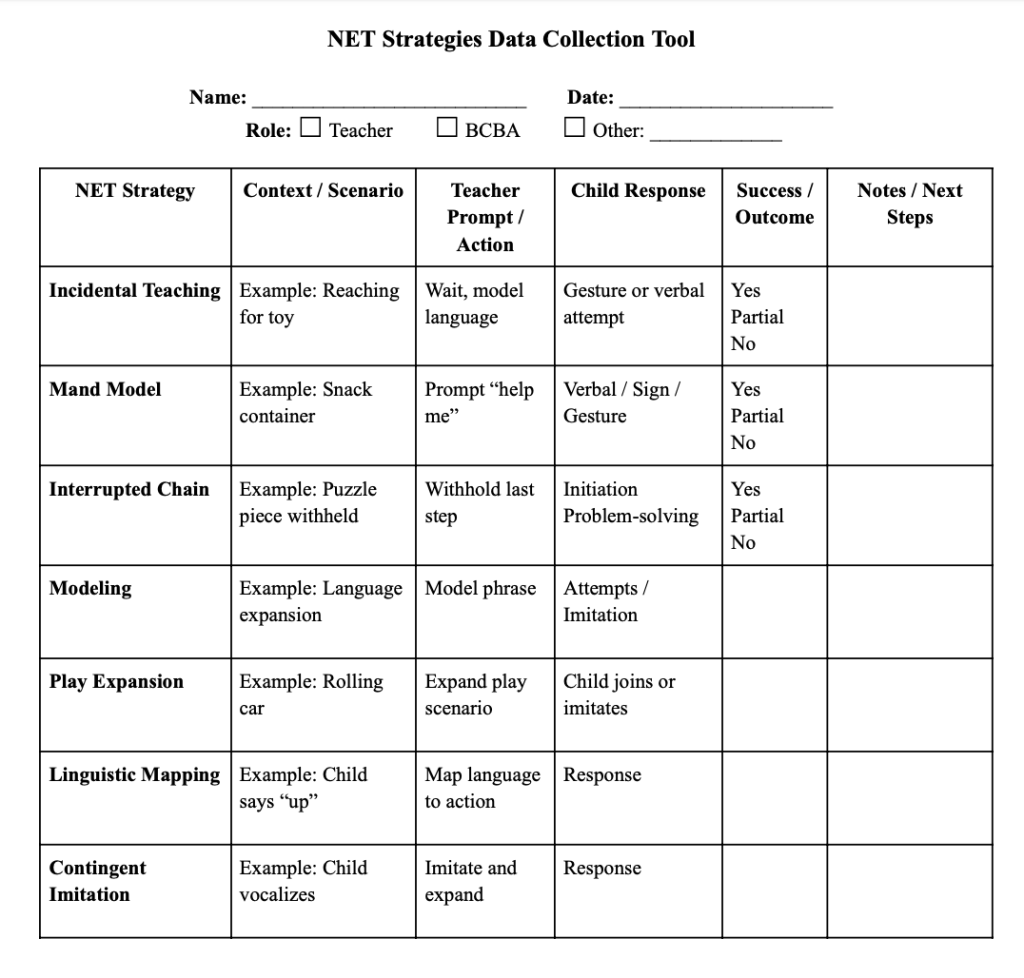
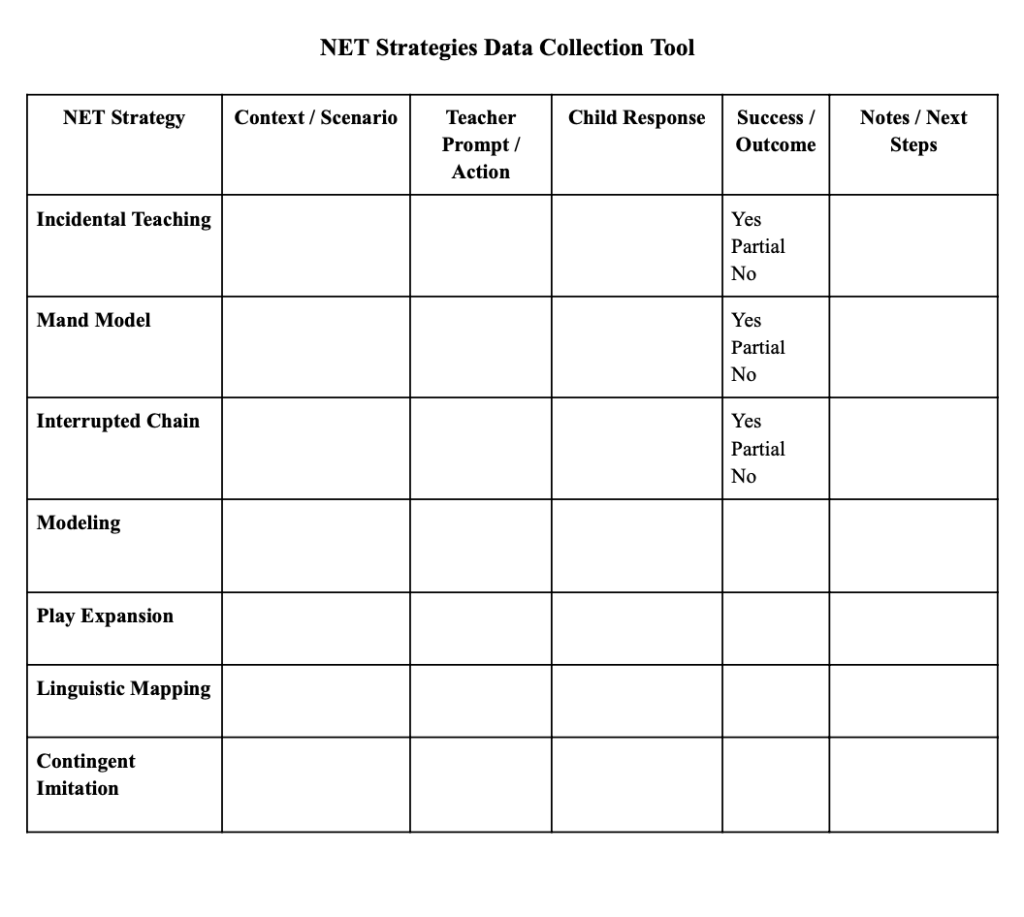
Data Collection Tool
Coaching and Self-Checklist
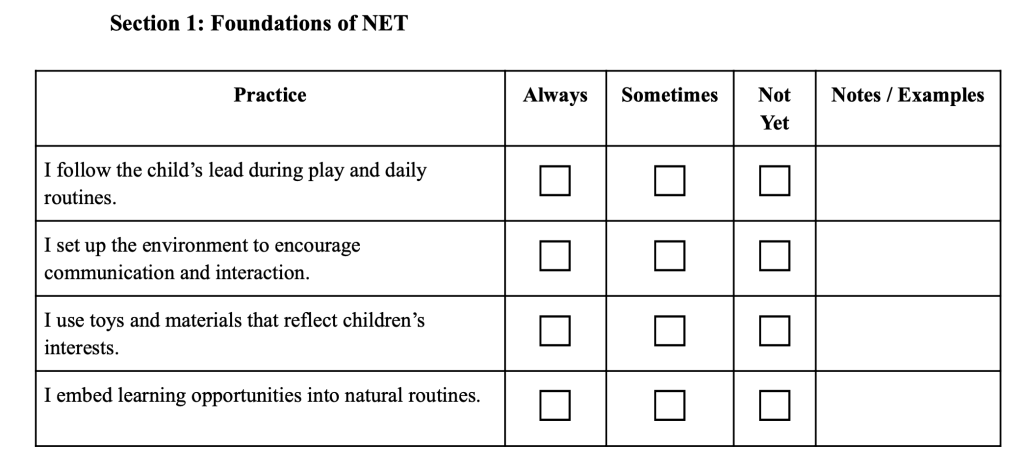
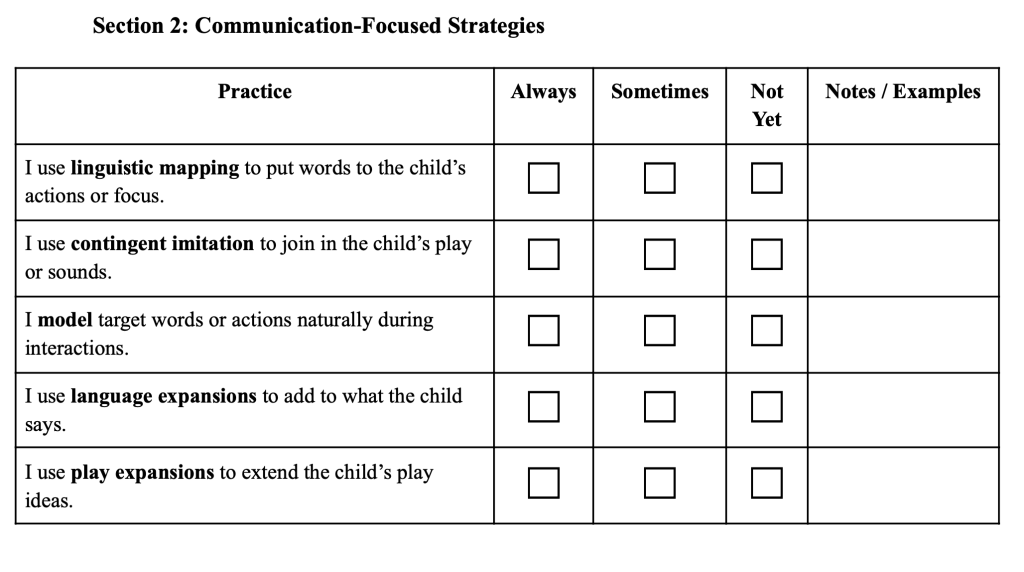
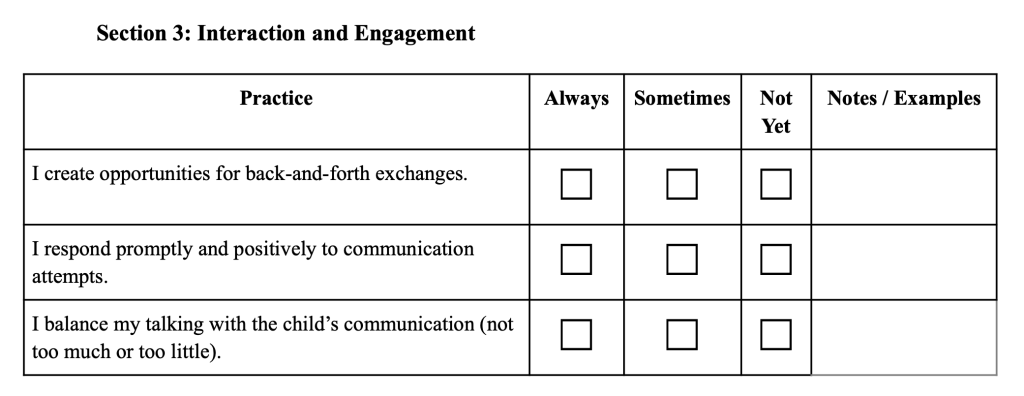

Resources for Teachers and BCBAs
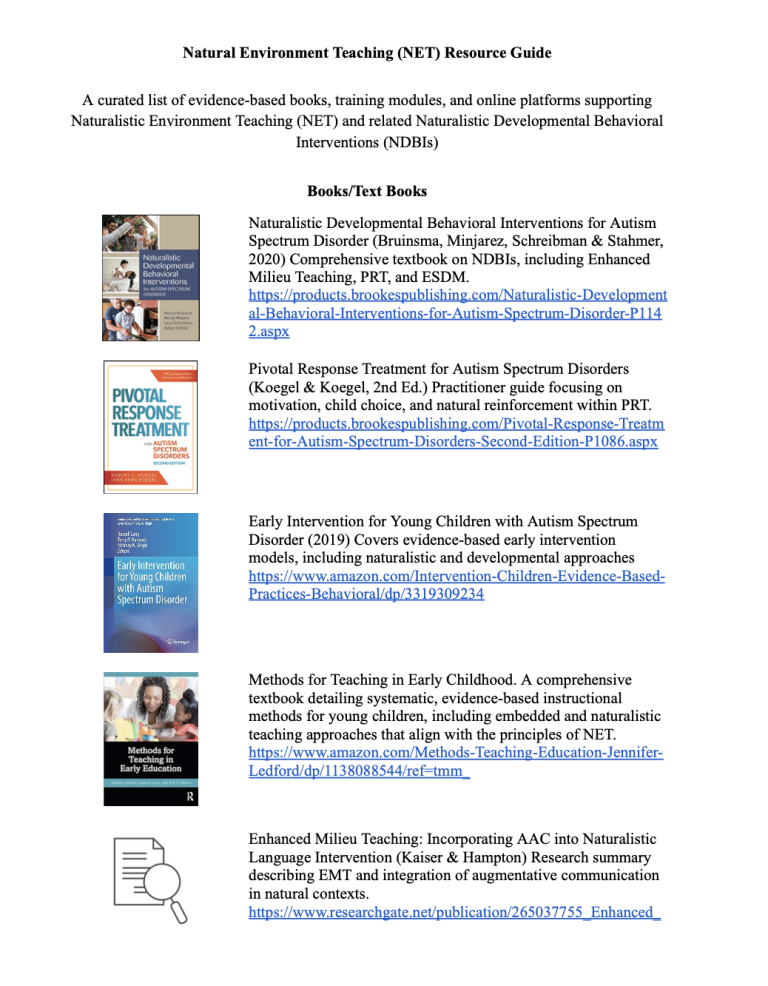
Additional Resources
Halle, J. W., & Anderson, S. R. (1984). Natural environment language assessment and intervention with severely impaired preschoolers. Topics in Early Childhood Special Education, 4(2), 36-56. https://doi.org/10.1177/027112148400400204 (Original work published 1984)
Koegel R. L., Williams J.A. Direct versus indirect response-reinforcer relationships in teaching autistic children. Journal of Abnormal Child Psychology. 1980 Dec;8(4):537-47. doi:10.1007/BF00916505. PMID: 7462531
Sandbank, M., Bottema-Beutel, K., Crowley, S., Cassidy, M., Dunham, K., Feldman, J. I., Crank, J., Albarran, S. A., Raj, S., Mahbub, P., & Woynaroski, T. G. (2020). Project AIM: Autism intervention meta-analysis for studies of young children. Psychological Bulletin, 146(1), 1–29. https://doi.org/10.1037/bul0000215
Schreibman, L., Dawson, G., Stahmer, A. C., Landa, R., Rogers, S. J., McGee, G. G., Kasari, C., Ingersoll, B., Kaiser, A. P., Bruinsma, Y., McNerney, E., Wetherby, A., & Halladay, A. (2015). Naturalistic developmental behavioral interventions: empirically validated treatments for autism spectrum disorder. Journal of Autism and Developmental Disorders, 45(8), 2411–2428. https://doi.org/10.1007/s10803-015-2407-8